Tissue-Integrated Bionic Knee: A Breakthrough in Orthopedic Prosthetics
Introduction
Loss of a limb significantly affects mobility, independence, and quality of life. For decades, most prosthetic limbs relied on socket-based attachments, where the artificial limb fits over the residual limb. While these devices restore some mobility, they often cause discomfort, instability, and limited control.
Recent advances in orthopedic engineering have led to the development of tissue-integrated bionic prostheses, a new generation of artificial limbs designed to function more like natural limbs. One of the most groundbreaking innovations is a tissue-integrated bionic knee prosthesis, developed by researchers at the Massachusetts Institute of Technology (MIT), which directly connects the prosthetic limb to the user’s bone, muscles, and nervous system. MIT
How the Technology Works
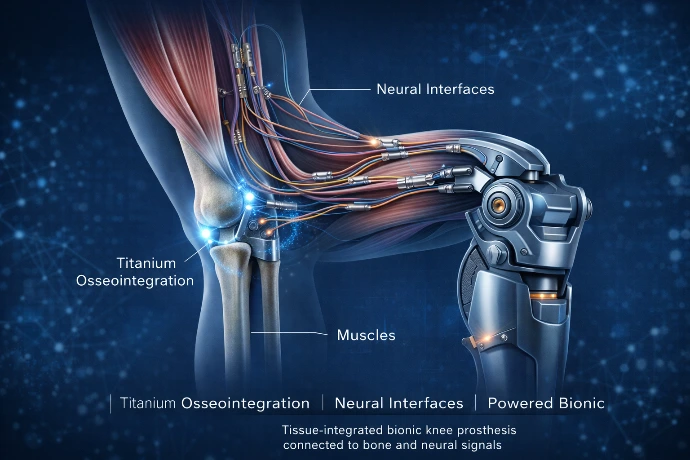
The new prosthetic system differs fundamentally from traditional artificial limbs. Instead of using a removable socket, the prosthesis is anchored directly to the bone using a titanium implant through a process called osseointegration. mcopro
The system also incorporates electrodes that connect with the user’s muscles and nerves. These interfaces allow neural signals from the body to control the prosthetic limb in a more natural way.
The technology typically involves three major components:
1. Bone Integration
A titanium rod is surgically implanted into the femur or remaining bone. The prosthetic limb attaches directly to this implant, creating a strong mechanical connection.
2. Neural Interface
Electrodes are implanted in muscle pairs around the joint, allowing the prosthesis to receive signals from the nervous system.
3. Powered Bionic Joint
Sensors and motors within the prosthetic knee interpret the neural signals and generate appropriate movement.
This integration allows the prosthetic limb to behave as part of the user’s body rather than as an external tool.
Clinical Benefits
Early studies of this new prosthetic system show remarkable improvements in mobility and control compared with traditional socket-based prostheses.
Key benefits include:
Improved walking ability
Users can walk faster and more naturally than with conventional prosthetic limbs.
Better balance and coordination
The prosthesis responds more accurately to neural signals, improving stability during movement.
Ability to climb stairs and navigate obstacles
The powered knee joint allows complex movements that were previously difficult for amputees.
Enhanced sense of limb ownership
Because the prosthesis interacts directly with the body’s muscles and nerves, users often feel the artificial limb as part of their body. livescience
Why This Innovation Matters
Traditional prosthetic limbs have changed little over the past century. By integrating prosthetic devices with the human nervous and musculoskeletal systems, researchers are now creating neuro-bionic limbs that mimic biological movement.
This innovation represents a major step toward restoring natural limb function for individuals with amputations.
Researchers believe that future versions of these devices may include:
advanced AI-controlled movement
sensory feedback to restore touch
improved neural interfaces
personalized biomechanical design
Together, these technologies could dramatically improve rehabilitation outcomes and quality of life for millions of people living with limb loss.
Future Outlook
Tissue-integrated prosthetic limbs are still undergoing clinical testing, but early results are promising. As surgical techniques, robotics, and neural interface technologies continue to evolve, prosthetic limbs may soon function almost indistinguishably from biological limbs.
Orthopedic research is moving toward a future in which prosthetic devices are fully integrated with the human body, restoring mobility, independence, and dignity to people with limb loss.
References
MIT News – Bionic knee integrated into tissue restores natural movement. MIT
EurekAlert – New prosthesis links muscles and nerves for improved mobility.EUREK SCIENCE
Smithsonian Magazine – Integrated prosthetic limbs improving movement in amputees. smithsonianmag
Live Science – Bionic knee connects directly to muscles and bone. LIVE SCIENCE